
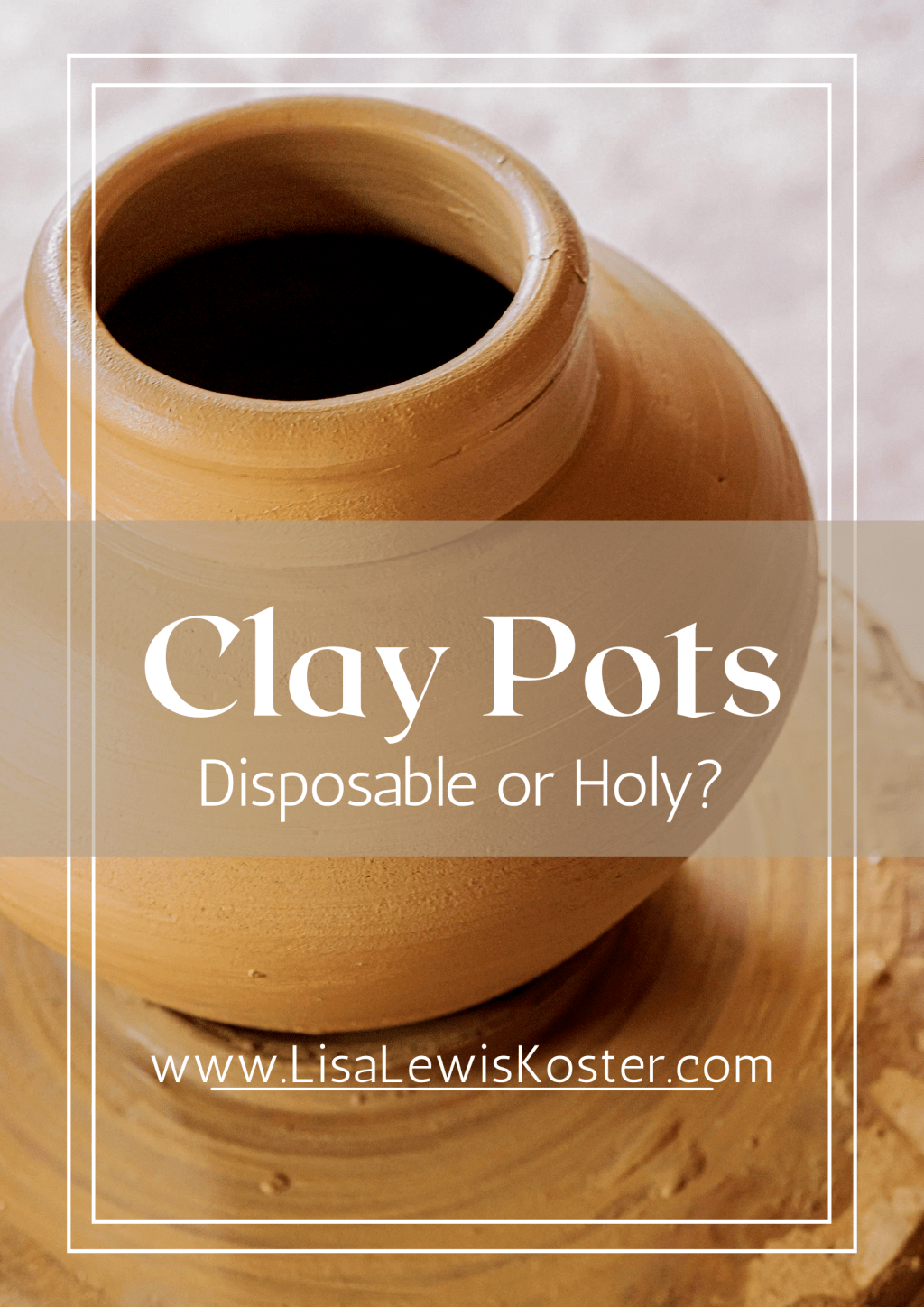

If you look under my potting bench, you will see a dozen or so plastic pots in varying sizes. My goal is to hit that sweet spot between saving every single pot and having the size I need when I need it. When I was growing up, the pots in our garage were not plastic, but terracotta. The name of these clay pots comes “from the Italian term ‘terra-cotta’, which literally means ‘Baked Earth’”[1] (Hey, now we know some Italian!)
In my opinion, terracotta pots look much nicer than the plastic ones, but they have their drawbacks. One of the problems with these clay pots is that they crack and break easily; they are fragile. Clay is also porous. These pots soak in particles of whatever is placed in them.
In 2 Corinthians 4:7-10 (chapter 4, verses 7-10), the apostle Paul says, “But we have this treasure in jars of clay to show that this all-surpassing power is from God and not from us. 8 We are hard pressed on every side, but not crushed; perplexed, but not in despair; 9 persecuted, but not abandoned; struck down, but not destroyed. 10 We always carry around in our body the death of Jesus, so that the life of Jesus may also be revealed in our body.” (NIV).
Paul is comparing our bodies to jars of clay, which doesn’t sound like much of a compliment to me. But what is the treasure he’s referring to? Notice the passage above begins with the word “but.” “But” always signals a contrast[2], so we want to compare what comes before “but” with what comes after it. In the verse just before this passage we read, “For God, who said, “Let light shine out of darkness,” made his light shine in our hearts to give us the light of the knowledge of God’s glory displayed in the face of Christ” (2 Corinthians 4:6, NIV). Our bodies are temporary, like clay pots, but the Spirit of Christ lives in us, and He is eternal.
It is important for us to remember that the Bible Paul read is what we now call the Old Testament. Being a Pharisee, Paul knew it well.
All of it.
Even the book of Leviticus.
And I believe Paul was thinking of Leviticus when he compared our bodies to jars of clay.
Leviticus begins by describing the different types of offerings. The first time we see clay pots mentioned in Scripture is in Leviticus 6:24. Within the regulations for a sin offering, we are told the priest may eat this offering of meat, but he must eat it in the tabernacle courtyard because it is holy. “Whatever touches any of the flesh will become holy…The clay pot the meat is cooked in must be broken; but if it is cooked in a bronze pot, the pot is to be scoured and rinsed with water” (Lv 6:27-28).
Having been raised to be thrifty, my first thought was, “What a waste. Use a pot once and then destroy it?” The key here is to remember that clay pots are porous. The clay soaks up molecules of whatever is in it. Once the offering is presented to God, it becomes holy. Right down to the molecules that soaked into the clay pot. The non-porous bronze pot can be scrubbed clean, but scrubbing will not remove the molecules of the offering found in the clay.
Just one molecule of holiness makes the entire clay pot holy. Because it is holy, it can no longer be used for ordinary purposes. The pot is broken, not because it is useless, but so there is no chance of it being used improperly. It is not merely discarded. It is buried, because it is holy.
In 2 Corinthians 4:6, Paul is comparing our bodies to those clay pots. Being created in God’s image makes these clay pots we call bodies holy.
Like them, we absorb what we are filled with.
We absorb what we are filled with.
Think about that.
What have you been filling yourself with lately?
Healthy food or junk food?
Enriching entertainment or corrupt?
Uplifting music or profane?
Are you filling yourself with the things of God, or are you filling yourself with the ordinary?

[1] https://bovees.com/terracotta-vs-clay-pots-for-plants/?expand_article=1 accessed 1 April 2024.
[2] Lisa Lewis Koster, Enough: Finding Contentment in a World of Wanting and Wandering, 148.
 Lisa Lewis Koster
Leave a comment