“To the angel of the church in Sardis write: These are the words of him who holds the seven spirits of God and the seven stars. I know your deeds; you have a reputation of being alive, but you are dead. 2 Wake up! Strengthen what remains and is about to die, for I have found your deeds unfinished in the sight of my God (Revelation 3:1-2, NIV).
Sardis is an ancient city, dating back to 1400 BCE. That is around the time of Moses! Sardis, now in modern-day Turkey, was the capitol city of Lydia. Croesus, the last of the Lydian kings, ruled in Sardis from 560 BCE to 546 BCE. Nearby stood snow-capped Mount Tmolos. As the snow melted, it flowed into the Pactolus River and through the central marketplace of Sardis.

It was believed that Dionysus, the Greek god of wine and partying, was “born” in Sardis. Perhaps this is because of the abundance of vineyards in the area.
Slavery was quite common in that day, but you may be surprised to learn that you might know of a slave born in Sardis. His name was Aesop and he collected stories. One of his fables was about a king named Midas.
In his tale, King Midas was drinking with Dionysus. In a jovial mood, the “god” granted Midas one wish – that everything he touched would be turned to gold. At first, it was great fun for Midas to touch things and watch them transform. Suddenly, things took a serious turn. He could not eat because his food would turn to gold when it reached his mouth. Returning home, his daughter rushed out to greet him. Not thinking, he embraced her and instantly she, too, was turned to gold. Midas rushed back to Dionysus, pleading with him to reverse this gift that he now views as a curse. Dionysus instructs Midas to wash his daughter in the river, and when he does, the gold falls away into the river bed and his daughter is restored.
Would you believe that one portion of this fable is actually true?
The Pactolus riverbed did contain gold and silver – and a lot of it! Perhaps Aesop wrote this fable to explain how these precious metals got there. In truth, the waters flowing from Mount Tmolos carried gold and silver from the mountaintop down to the valley below. This made Sardis, and King Croesus, very rich.

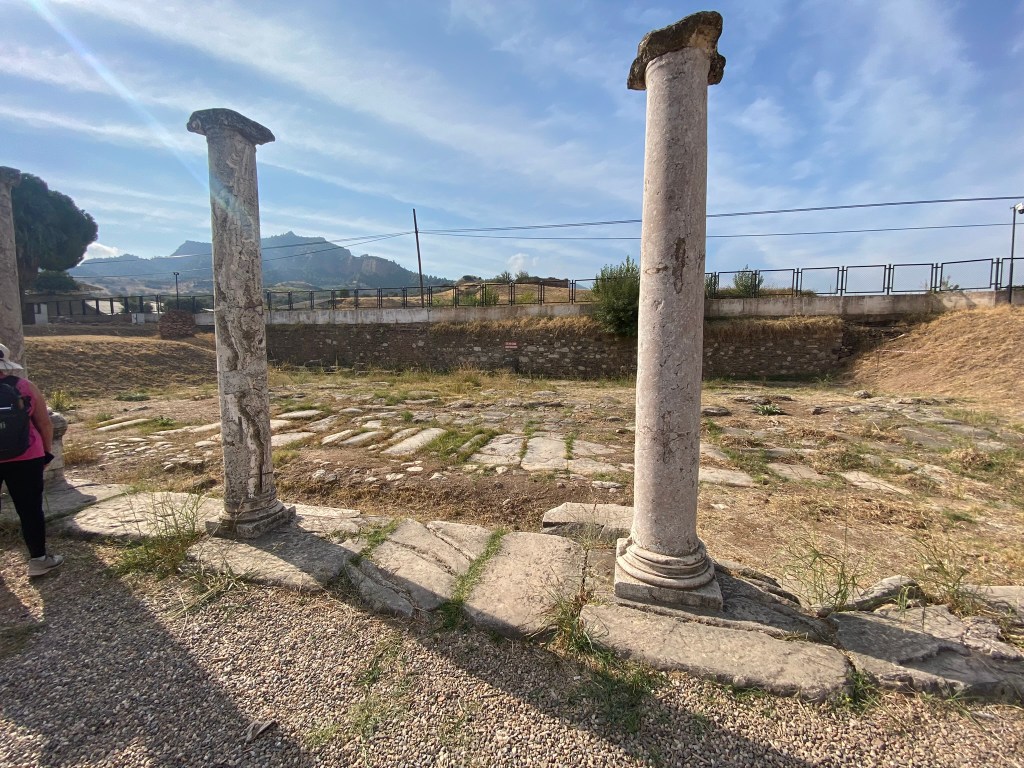
Sardis was located on one end of the Royal Road, with Persia’s capital of Susa on the other end, 1,677 miles away. In 546 BC, King Cyrus II and his Persian army came and defeated Sardis, killing King Croesus.
Approximately 100 years later, Sardis was the westernmost province of the Persian Empire. The Jewish population of Sardis was threatened with destruction by the edict of a man named Haman. Letters were sent by couriers to all the king’s provinces with instruction to destroy, to kill, and to annihilate all Jews, young and old, women and children…(Esther 3:13, ESV). Only Esther’s quick thinking and bravery saved the Jewish people throughout the Persian Empire, including those of Sardis.
Sardis was home to the fourth largest temple in the ancient world, the temple of the goddess Artemis. Worship was frantic. White clothing was worn. Sacrifices were made over a fine grate. As a person entered the temple they walked under the grate. Their white clothing became spattered with blood. Continuing in Revelation we read, Yet you have a few people in Sardis who have not soiled their clothes. They will walk with me, dressed in white, for they are worthy (Revelation 3:4, NIV).
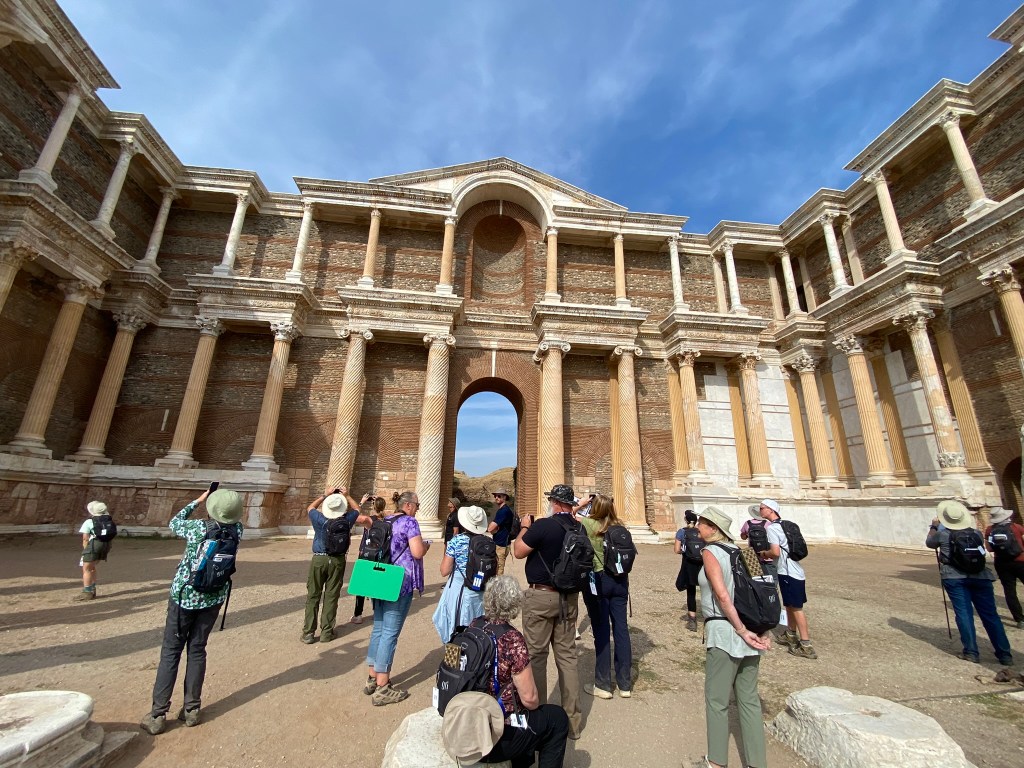
Sardis also had a synagogue, the largest in the ancient world. It was huge, 164 feet long, and held 1,000 people. It was also luxurious, with mosaic floors throughout. Unfortunately, it showed signs of compromise. Inscriptions from the synagogue show the Jews being citizens of the city and using Greek names.

The synagogue was located in a complex that also featured a gymnasium and a bathhouse. That is a lot of nakedness just outside of a place of worship! (The word “gymnasium” actually comes from the Greek word for nakedness, “gymnos.”)
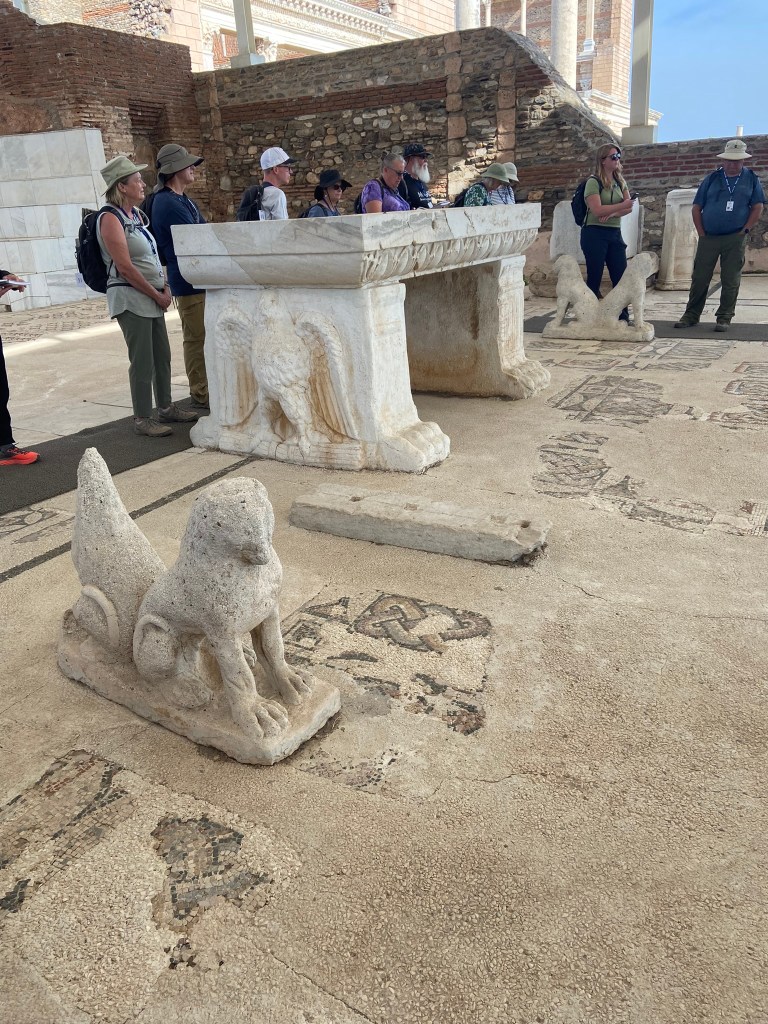
Normally a synagogue does not contain any images, for God said, You shall not make for yourself an image in the form of anything in heaven above or on the earth beneath or in the waters below (Exodus 20:4, NIV). Yet inside, at the front of the synagogue, there is an altar with a carving of a large eagle on each end. On either side of the altar stands a statue of two lions sitting back-to-back. This altar and statues are “the only known case of pagan sculpture being reused in a synagogue.” [1]
[1] Mark Wilson, “Biblical Turkey,” p. 305.
These symbols are particularly problematic because they were signs of power. Lions represented the goddess Artemis, while the aquila (Latin for eagle) was the symbol of the Roman military. However, the eagles were intentionally beheaded prior to being used in the synagogue. And perhaps they considered the lions as representing the Lion of Judah…
It has never been easy to live in the world without being compromised by it. There is always the question of where to draw the line. But we are blessed to have Scripture to teach us about God and His ways. Unlike those in ancient days, we also have God’s Spirit within us to guide us each and every day. And He will never leave us nor forsake us.
Many ancient cities had a book that listed all of its citizens. However, if a person committed a crime, their name was blotted out. Yet God says in Revelation 3:5 The one who is victorious will, like them, be dressed in white. I will never blot out the name of that person from the book of life (NIV).


 Lisa Lewis Koster
Leave a comment