
On a recent trip to Turkey, I was able to visit several of the cities mentioned in the book of Revelation. I previously wrote about the letters to Sardis and Laodicea. Here we will dive into the letter to Pergamum. You may not be familiar with this city, but it was very important in the ancient world. It was second only to Ephesus, because that city had a port while Pergamum did not.
Rev 2:12 “And to the angel of the church in Pergamum write:
Pergamum was designated as a free city within the Roman empire, which gave them the right to choose their own leaders. They were also granted ius gladii (ooohs gladee) – the right of the sword. This distinction gave the governor power to impose the death penalty when he deemed necessary.
At that time, armies used double-edged swords. In those cultures, the sword represented the highest level of authority and power. So when Jesus begins His letter by saying, ‘The words of him who has the sharp two-edged sword…’ Christians understood this refers to Jesus, who is the ultimate authority. It is He alone who holds the power of life and death.
Rev 2:13 “ ‘I know where you dwell, where Satan’s throne is. The word translated “throne” describes the chair belonging to the head of a household. The use of this phrasing indicates that, at a minimum, Satan felt at home in Pergamum. He believed this was his territory; he was in charge.
Yet you hold fast my name, and you did not deny my faith even in the days of Antipas my faithful witness, who was killed among you, where Satan dwells.
Antipas, a disciple of John, became the bishop of Pergamum. Jesus called Antipas his “faithful witness.” The word “witness” is a translation of the Greek word martys; and yes, this word can also be translated as martyr. Antipas is indeed a martyr, experiencing a very brutal form of death. Placed inside a bull made of bronze, a fire was then lit beneath it. His screams were converted into sounds so it appeared as if the bull was coming to life as he was cooked to death.
Rev 2:14 But I have a few things against you: you have some there who hold the teaching of Balaam, who taught Balak to put a stumbling block before the sons of Israel, so that they might eat food sacrificed to idols and practice sexual immorality.
Are you familiar with the account of Balaam? (Hint: he’s the guy who got in an argument with his donkey). It is found in Numbers chapters 22-24. Balak, king of Moab, felt threatened by the large number of Israelites traveling through the desert on their way to the Promised Land. Balek sent his men to hire Balaam to curse the Israelites. Balaam, a lover of riches, did his best to curse them; but every time he tried, God allowed him to only speak blessings. Numbers chapter 24 ends with Balak and the unsuccessful Balaam parting ways.
Then Numbers 25 begins by saying, “While Israel was staying in Shittim, the men began to indulge in sexual immorality with Moabite women, 2 who invited them to the sacrifices to their gods. The people ate the sacrificial meal and bowed down before these gods. 3 So Israel yoked themselves to the Baal of Peor. And the Lord’s anger burned against them” (NIV).
What happened? After three chapters of blessings, how did the Israelites come to be the recipients of God’s wrath? The answer is Balaam. Since God kept him from cursing the Israelites, and because he loved money, he informed Balek how to entice the Israelites to bring curses down on themselves. We know this because of a cross-reference found in Numbers 25:1, which sends us ahead to Numbers 31:16. There we learn Balaam instructed the Moabite women to lure the men to their city to enjoy passion followed by a meal of meat sacrificed to idols. History is repeating itself in Pergamum, and God is not pleased.
Rev 2:15 So also you have some who hold the teaching of the Nicolaitans. Interestingly, the names Balaam (Hebrew) and Nicolaitans (Greek) share the same root words. Translated, they each mean “conquer people.” Basically the Nicolaitans did the same thing Balaam did. They encouraged God’s people to engage in sexual immorality and eat meat sacrificed to idols. Their faith was one of compromise.
Rev 2:16 Therefore repent. If not, I will come to you soon and war against them with the sword of my mouth. 17 He who has an ear, let him hear what the Spirit says to the churches. To the one who conquers I will give some of the hidden manna, and I will give him a white stone, with a new name written on the stone that no one knows except the one who receives it.’
This letter began by saying Pergamum is “where Satan’s throne is.” Some people have taken this to mean there is literally one place where Satan has his throne. Although there is no agreement as to where this place is, there are many options:
The temple of Asclepius, the god of healing. While Asclepius is just one of many false gods represented in Pergamum, his temple was actually a hospital. Although if you were dying, you wouldn’t be admitted because death wasn’t allowed in the Asclepieion. Nor was childbirth, since the death rate for both mothers and babies at that time was 50%. Those who were healed at the Asclepieion etched their name on a white stone pillar.

The Great Altar of Zeus, which once stood on the acropolis, is now in a museum in Berlin. Measuring 212 feet x 112 feet square, it was the second-largest in the ancient world. When incense was offered on Zeus’ altar, the scent wafted through the city.

The temple of Dionysus (god of the arts, theater, wine and partying) was located next to the steepest theater in the world. At festival you’d drink bull’s blood and eat the raw meat so you’d have the body and blood of Dionysus. This was the ultimate act of allegiance to Dionysus.
The temple of emperor Augustus (27 BCE –14 CE). In 44 BCE Augustus deifies his adopted father, Julius Caesar. This makes him a “son of god.” When the book of Revelation was written, the imperial cult of emperor worship was strongly promoted in Pergamum. This temple has not yet been found.
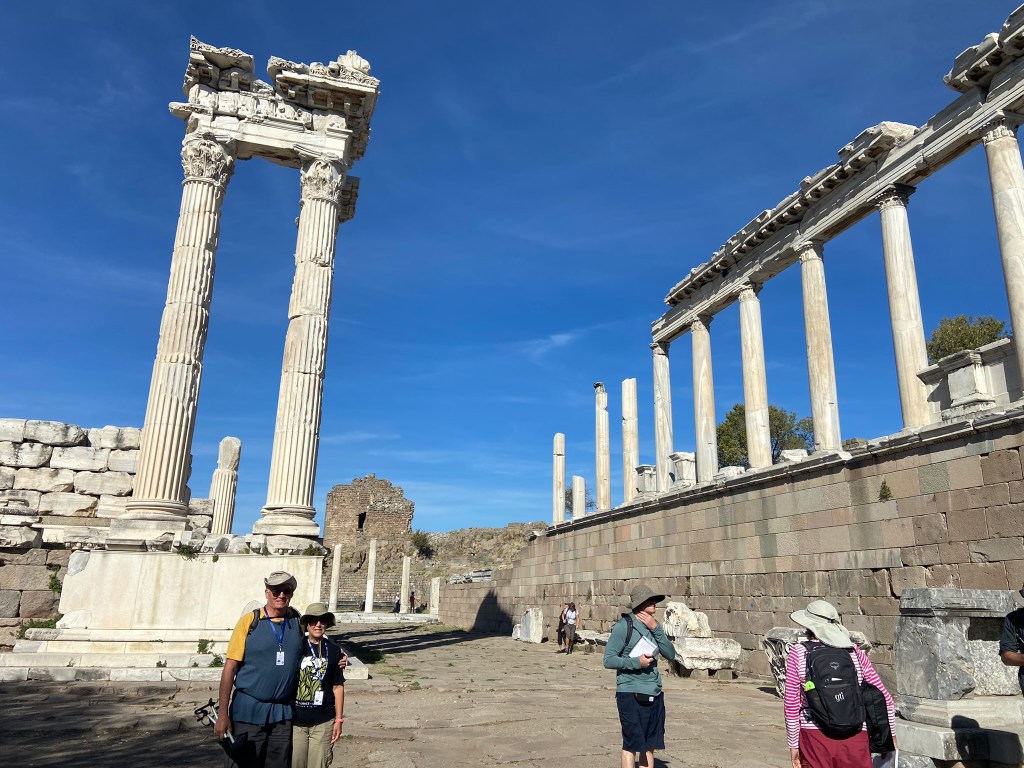
The temple of emperor Trajan (98-117 CE), dominating the summit of Pergamum, declared Trajan the ruler of the city.
With a rumored 17 temples in Pergamum, it seems likely that the entire city could be considered the throne of Satan. Notice we are told twice that Satan dwells here. The Bible uses repetition to emphasize a point. Pergamum was definitely one of the most wicked cities in the history of the ancient world.
Imagine how difficult it must have been for believers to stand strong in their faith, especially after witnessing the torture of Antipas. Yet they held fast to Jesus’ name, and did not deny their faith in Him.
Are we doing the same?



 Lisa Lewis Koster
Leave a comment